 Much as I loved strolling through Mughal history at the Taj and Agra Fort, it was now time for some indulgence of the culinary kind. Agra was the capital of the Mughal emperors for over 120 years; in addition to their love of art, they also gave India its Mughlai cuisine - tandoori meats and naans, fragrant biryanis and richly spiced qormas. There is no better place here to dine like the royals than the exquisitely appointed Indian restaurant, Esphahan, at the Oberoi Amarvilas.
Esphahan, like the rest of Amarvilas is simply stunning. Intricate wood-carved screens, pillars of red sandstone and marble, a display kitchen and live santoor recitals makes for a memorable dining experience. The menu has many interesting options: the Esphahani raan is an entire leg of lamb marinated for over 24 hours in Indian spices and slow roasted on tandoor; the Balai ka Jheenga made of tiger prawns marinated in black pepper and homemade cream. The waiter also recommended the Bharwaan Gucchi Malai which is Kashmiri morel mushrooms stuffed with paneer and raisins and the Aab Gosht, a lamb dish in which the meat is braised in milk and flavored with ginger and fennel.
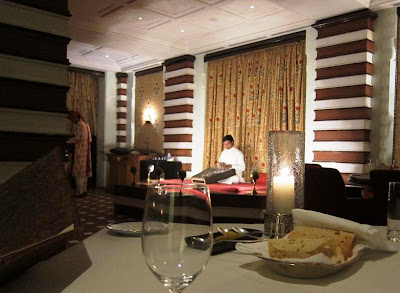 We decided to go with the elaborate thali which was served in three courses. They sent across a ornate cup of rasam to begin with. Unlike the real thing, this was spiced mildly for foreign palates. Thoughtfully, they brought a kid-friendly melon soup instead of the rasam for my young daughter.
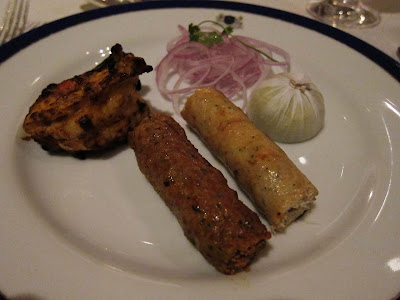
 Then came a platter of kababs: succulent tandoori tiger prawn, and two different sheek kababs, one made of minced lamb the other of chicken, each differently spiced and flavored. All kababs were expertly made and delicious.
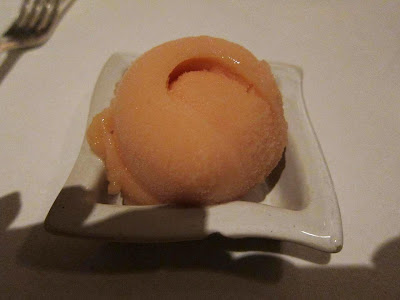
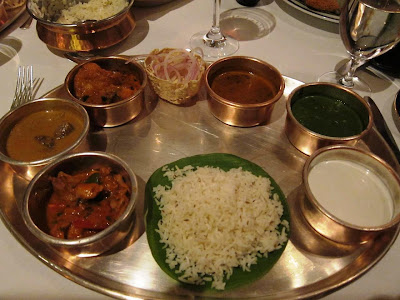
 After a palate cleanser of guava sorbet, we were presented with a large bronze thali filled with bowls of qurmas, kaalias, daal, raita, sabzi and basmati rice. Every dish was good and distinct in flavoring and taste - a lot of thought had gone into getting the combination right. Executive Chef Sandeep Pande came out to our table to check if we were doing alright; we had only compliments to give him for tonight's meal.
 The santoor player was very good and we enjoyed working through our food slowly as we sipped our wine and listened to his music.
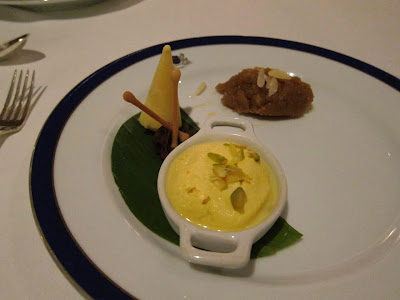
The desserts included a traditional kulfi, rasmalai and moong daal halwa - all traditional North Indian specialities. The entire dinner took us over two hours. Esphahan opens for two dinner seatings: at 7:30 PM and 10:30 PM. Reservations are necessary and they recommend not bringing kids below the age of eight.
 Bellevue, the other all-day dining restaurant also served us some wonderful meals during this visit. They even brought us the Esphahani raan from their kitchen (not on the Bellevue's menu) on another day - the dish was excellent and I highly recommend trying it if you enjoy lamb.
 On our final day, we drove down to the fort city of Fatehpur Sikhri, constructed by Akbar in honor of Saint Salim Chisti who foretold the birth of his son, Salim, who later succeeded him to the throne as Emperor Jahangir. This city, which took 15 years to build, was only occupied for 15 years; water problems made it difficult to sustain the growing population. Now that sounds familiar!
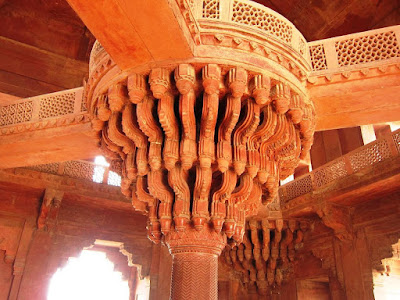
 Fatehpur Sikhri has some wonderful examples of Mughal architecture such as the elaborately carved Deewan-e-Khas, the Meena Bazaar courtyard where queens and princesses showcased their talents to attract attention of the king, and the royal pool of the emperor with seats for his queens all around the edges to attend to him while he bathed!
 However, a warning to all new visitors: the touts, guides and salesmen here are a nuisance and can completely spoil your vacation experience. They will keep harassing you and it will take a great deal of patience. The best way to deal with them is to ignore them and not engage them in conversation. This is something that needs to be managed better by the Agra authorities; I could see many tourists harassed and virtually forced to buy souvenirs.
 The drive to Fatehpur Sikhri takes over an hour by car, and by the time we got back all we wanted was a quick dip in the pool and some more of those great cocktails as we swam around in the deep blue waters. But there was more pleasurable moments coming up. We had made appointments at the Oberoi Spa. Our masseuse from Nagaland was extremely proficient. The spa suite was on the top level of the hotel with a clear view of the Taj in the distance. The heated bed, the expert hands, the soft music and the fragrant incense sticks made for a magical time.
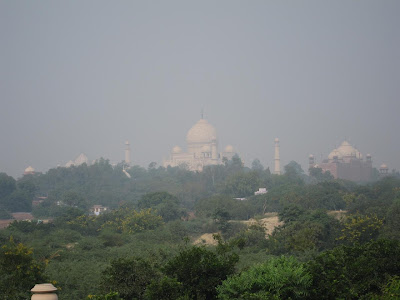 Finally, it was time to get back to the real world. With a last glance at the timeless Taj, we checked out and headed back to the airport. We carried back some of Agra's specialities: pethas and dalmoth from Panchi Sweets and marble inlay work from Kalakriti.
Please note that Kingfisher Red has one flight every day from New Delhi to Agra during the peak season (non-summer months). The airport itself is very quaint and shared with the Air Force so you can see some gaint transport aircraft taking off if you are lucky.
Read More...

 My wife and I had a rare day to ourselves when our daughter planned a day trip with her friends. On a whim, we decided to drive down to Mulshi, a popular picnic spot on the outskirts of Pune that is particularly alluring during the monsoons. This turned out to be one of the better ideas we have had lately. Mulshi was everything it promised to be and more. Mulshi was green, lush, and open all around with a large lake in the middle that fed into the dam - nature at its prettiest. On the day we were here, there were few tourists which made this visit even nicer.


