Friday, March 13, 2009

The Bukhara Revisited

Bukhara New DelhiDelhi always makes me nostalgic. As I passed through Connaught Place recently and saw Wimpy's and Nirula's, I was reminded of a time when it was über-cool to hang out here. A time when this was the closest thing to American-style fast-food and ice-cream parlours in the country. Of going back to Lucknow and talking about the 21 varieties of ice-creams available here. I remember my favorite was called Manhattan Mania, a rich creamy ice-cream cone with glazed fruits and nuts. During my early days in New Delhi, the five-star hotels were out of my reach. For me then, the epitome of fine dining was at Berco's in Connaught Place which served Chinese food and we would wait for as long as an hour for a seat.

Lobby of the Maurya Sheraton New DelhiOver the years, I could afford more upscale - and expensive - restaurants, and I remember my first visit to the famous Bukhara at the Maurya Sheraton. Already a foodie, I had heard of this place - especially about how this was the favorite dining spot of then Prime Minister Rajiv Gandhi and many visiting heads of state. That dinner was a dream dinner for me, one that I carried in my memory for a long time.

Artwork at the Maurya Sheraton New DelhiTrying to figure out a place to have my lunch before checking out of the Taj, I was suddenly reminded of the Bukhara, right next door. I wondered if I would find the Bukhara as delightful as that first time. Let me tell you now, there is a reason this restaurant is rated the best in New Delhi by many. There menu remains the same with a few good kababs, exotic Indian breads and the world famous Dal Bukhara. But no one - no one! - makes them quite like the Bukhara does.

Lunch at the Bukhara New DelhiI ordered the Tandoori Pomfret, Bharvan Kulcha, and Dal Bukhara. The fish was simply amazing: large, with a moist, flaky interior covered with a crispier outside coating with the best tandoori masala ever. The Kulcha and the Dal were exceptional too; you can’t make them any better. Even the laccha onions they serve along with the food seemed perfect – sprinkled with a zesty chaat masala.

Tandoori Pomfret at Bukhara New DelhiI ended with a Phirnee dessert. The phirnee was good, flavored with saffron, but not as delightful as the rest of the meal was. They encourage you to eat with your bare hands at the Bukhara, and trust me, that’s the best way to enjoy a meal here.

Phirnee at Bukhara New DelhiBukhara’s décor of a North West Frontier tavern, chain iron curtains, seating made of logs tied with ropes, etc., have now been copied in many restaurants. What remains unique is the large and distinct red-checkered apron they tie around your neck before you begin attacking your meat with your bare hands!

Bukhara New DelhiBukhara was one of ITC Hotels’ first attempt at branded upscale restaurants and was an instant success. While their other branded restaurants such as the Dum Pukht, Dakshin and the Peshawari have been replicated in their other hotels in Indian metros, there is only one Bukhara – in the Maurya Sheraton at New Delhi. A restaurant Bill Clinton never misses visiting when he’s in town. Bukhara is named after the Uzbek city located on the ancient Silk Route and famous as a center of art, religion and culture during the Persian empire. The invading hordes that came to India from this region brought mayhem and destruction, but also gave us our kababas and biryanis. Like they say, every cloud has a silver lining!

Read More...

Tuesday, March 10, 2009

Gourmet Bullion

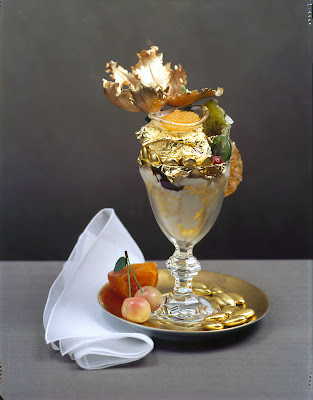
$1000 dessert at Serendipity New York CityThe festival of Holi nears, and sweet shops across the nation are resplendent with rows of colorful barfis, gujiyas and other yummy delights. You can't avoid noticing how many of these sweets are covered with a thin foil of silver. For centuries these edible, gossamer-thin sheets of pure silver (or even gold during our princely past) have been popular decorations for special-occasion desserts, confections, even nuts and pulao.

Warq or varak, can be easily found in Indian markets. These gold- and silver-leaf sheets usually come in packs of twenty-four, with each delicate foil sandwiched between two sheets of paper. Warq sheets are so fragile they dissolve easily with human touch and can be torn by the barest breath of air. It is best to remove the top piece of paper from a sheet of wark, invert the warq on top of the food to be decorated. The warq will stick to the food, and the paper can be peeled off. Warq will keep indefinitely if stored in an airtight container (to prevent tarnishing) in a cool, dry place.

Silver warq on kaju rollsWarq is about a millionth of a millimetre thick and is used sparingly, though thoughtfully, in North Indian cuisine and some alternative medicines in India. What most people are unlikely to know is that this decoration on the pure vegetarian sweet is made by pounding silver or gold pellets between two sheets of leather. Animal hide! For some reason, all warq produced in India is still made the traditional way manually.

Silver Warq topped kaju rolls"It is an aphrodisiac," gushes Imtiaz Qureshi, grand master chef at ITC Grand Maratha in an interview with Times of India. "Nawabs and their courtesans alike were served warq in generous mounds." In the courts of the Nawabs of Awadh, warq was used to bedeck elaborate dishes combined with saffron, pista and almonds, says Qureshi. He makes special mention of the Kundan Qualiyan, the famed royal Awadhi dish that today’s non-royalty can try, albeit in a five-star hotel.

Kundan Qualiyan is made with tender morsels of lamb cooked in a saffron tinged thick gravy and served topped with a partially cooked egg yolk which when broken into the gravy adds to its golden hues. Further topped with gold leaf and saffron dyed almond slivers, this dish is as royal as they come. Gold warq is pure 24 carat. If other lower metals were added, the warq would break.

In the USA, in your nearest gourmet supply store, you can probably find, boxes of gold leaf (sheets, flakes, or sprinkles) to you to impress your friends at your next dinner party. These thin pieces of gold add an impressive touch to chocolates, sushi, and just about anything else you can think of. Because the quantity of gold is so small, the price is not unreasonable; yet these gold highlights make a meal appear to be extravagant and give restaurants excuse to charge exorbitant prices. And yes: it’s safe to eat; metallic gold is biologically inert, which is why dentists use it for fillings, caps, and crowns.

Valrhona Chocolate Sphere at Burj Al Arab"It is a tonic," insists Jiggs Kalra, veteran food expert in the TOI article. He talks about the tale of Shah Jahaan who was jailed by son Aurangzeb and allowed only one meal a day. "His doctor created a dish, Shahjahaani Korma, which kept him going and also alleviated his health problems."

Apparently, the dish contained gold. Few Lucknowi kitchens make Shahjahaani Korma today. However, gourmet chefs in India still conjure up Sone Chandi Ke Moong, Kofti Pulao with khoya slabs and lamb, and chicken biryani - all topped with warq. The top-end paanwala will sell you gulkand paan laced with gold.

However, the use of gold and silver in food was not restricted to India. These noble metals have been consumed for centuries by Native Americans, some of whom believed that eating pure pulverized gold can allow humans to levitate.

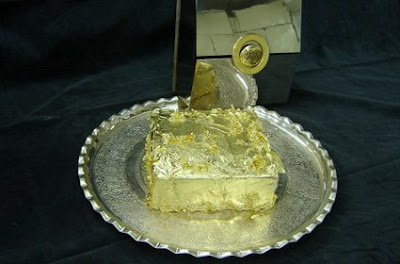
The Sultan's Golden Cake in Ciragon Palace Kempinski IstanbulSilver has been used as a medicine and preservative by many cultures throughout history. The Greeks and others used silver vessels for water and other liquids to keep them fresh. Pioneers trekking across the wild west generations ago faced many hardships. Keeping safe drinking water was one of them. Bacteria, algae, etc. found a fertile breeding ground in the wooden water casks that were carried on the wagons. They placed silver and copper coins in the casks to retard the growth of these spoilage organisms. They also put silver dollars in their milk to keep it fresh.

Settlers in the Australian outback still suspend silverware in their water tanks to retard spoilage. Silver water purification filters and tablets are manufactured in Switzerland and used by many nations and international airlines. Preventing growth of algae and bacteria in swimming pools is a similar problem that people face today.

The world's most expensive dessertWhile anyone India can get some sweets with silver warq on them in the neighboorhood sweet shop, gold warq is mostly found in upscale, gourmet restaurants. The world's most expensive dessert at the Serendipity restaurant in New York City is topped with gold leaf and costs $1000. If you are in Dubai, try the Valrhona Chocolate Sphere ($75 each) at Al Mahara, Burj Al Arab. Another extravagent gold-topped treat is the $1000 Sultan's Golden Cake at the Ciragon Palace Kempinski in Istanbul.

Eating gold and silver certainly beats eating out of them! :)

Read More...

Saturday, March 07, 2009

The Spice Route And More

Satish Gujral's Nandi at the Lalit New DelhiDuring my two days in New Delhi, I spent most of the time shuttling between hotels, from one meeting to another. While The Imperial in Connaught Place has existed for ever, I remember the Lalit too, but by a different name. Until recently, this hotel was the Intercontinental, and before that, I think it was the Sun-N-Sand. What do you think of a hotel that changes identity that often? Rather shady, methinks! However, I liked the new coffee shop at the lobby level and the stunning scultpure by Satish Gujral of Nandi, Lord Shiva's mythical bull.

During the ten years I lived in New Delhi, I hadn't ever ventured into The Imperial. The hotel with its lavish, regal interials first opened its doors in 1936, in the years after King George V declared New Delhi the new capital of India. Those days, the Janpath - on which this hotel is located - was called the Queensway, the place to see and be seen. The Imperial has hosted many leaders including Gandhi, Nehru, Jinnah and Lord Mountbatten. In more recent times, heads of state and Hollywood celebrities have made a beeline here during their visits to India. After a recent renovation, this place has been restored to its original glory and is among the best hotels in this city of djinns.

The Imperial in New DelhiThe Imperial is also home to one of the finest Southeast Asian restaurants in the city, The Spice Route. This restaurant was heralded as one of the top ten restaurants by Conde Nast Traveller some time back. The menu traces the journey of spices from the Malabar Coast of Kerala through Sri Lanka, Malaysia, Indonesia, Thailand and Vietnam. However, what strikes you most when you enter this restaurant is the overwhelming decor - I felt I was entering an ancient temple. There are elaborate ornate carvings and artwork on the roofs, walls, everywhere! They also have an open-air courtyard designed in the tradition of the Chiang Mai region of North Thailand.

The Spice Route New Delhi
The Spice Route New DelhiThe chef made us a special charcoal-grilled tiger prawns with a hot and sweet Thai sauce (not on their menu). We followed with the Thenkay Kozhi Curry from Kerala, boneless chicken legs in a thick red curry with whole spices. Both of them were excellent! The prawns were crunchy, smokey and went rather well with the sauce. The curry was very hot - the way I like it - and fantastic with the very flaky Malabar Parathas.

Charcoal Grilled Prawns at The Spice Route New Delhi
Thenkay Kozhi Curry at The Spice Route
Malabar Parathas at The Spice RouteOther interesting items on the menu were the Kukulmas Temperadu, a Sri Lankan curry of chicken and bell peppers, and Irachi Stew, a Kerala style stew of boneless lamb cooked with potato and coconut milk.

We ended by sharing a dessert of Thai Mango, with coconut sorbet and tangy tropical fruit salsa. As yummy as it looks (and sounds)! This restaurant also has an excellent wine list for those special dinners; btw, their wine glasses are almost a foot tall!

Thai Mango Dessert at The Spice RouteAnd finally, back at the Taj Palace - where I was staying - a quiet dinner at the end of another busy day. As a musician belted out pop hits from the 70s and 80s, I nibbled on an platter of mustard-marinated fish tandoori tikkas followed by a tri-chocolate mousse that was rather uninteresting on the palate. The lunch buffet in this restaurant is actually a lot more interesting with excellent desserts to boot. Note: Like always, hover over the pictures to get a description.

Mustard Marinated Fish Tikkas at Cafe Fontana

Tri-chocolate Mousse at Cafe Fontana
Lunch Buffet at Cafe Fontana
Desserts at Cafe Fontana New DelhiI had a flight to catch the next day. The departure terminal was still the old one but not too busy on this day; they are opening the spanking new one in early April which should improve the travel experience to New Delhi considerably.

Read More...

Monday, March 02, 2009

Masala Art

Bhatti Ka Jeenga at Masala ArtIn New Delhi for a couple of days, I found myself back at the elegant Taj Palace hotel. I had taken the early morning Kingfisher flight from Pune and was in meetings all day long. Travelling from one location to another during the day, I was glad this was one of those rare days in Delhi - neither too cold nor too hot! When the day ended, I was back in my hotel with no inclination to venture out again for dinner.

Luckily, the Taj is home to a few good restaurants. Their most famous is the Orient Express which traces the foods of the legendary train's journey in a fine dining experience. But today I was intent on trying their contemporary Indian restaurant, Masala Art. Boasting a show kitchen and a minimalist decor, the restaurant does add a few interesting touches. The one I liked the most was the 'phulka' trolley which makes hot, home-style phulka rotis at your table-side.

Stuff to munch at Masala Art
Luknowi Bhuna Gosht at Masala ArtThe Bhatti Ka Jeenga, char-grilled jumbo prawns with delicate spices, were rather good. However, what I really remember from the dinner was the Lucknowi Bhuna Gosht, succulent pieces of lamb cooked to perfection in a heady mix of spices. Especially with the home-style phulka rotis, instead of the standard naan or paratha. Cooked on griddles (and not the tandoor), these breads are staple fare at most North Indian homes. Many travellers tend to think of naan as the most common Indian bread. Actually, few Indian homes make use of the tandoor, which is only found in restaurants and parts of north-western India.

PhulkaFinally, for dessert they recommended the street-style Tilliwali Anjeer Kulfi, a frozen dessert of thickened milk and figs on a stick. At the end, they laid out a large assortment of Indian mouth fresheners of supari and paan.

Tilli Wali Kulfi at Masala Art
Supari platter at Masala ArtMasala Art is popular with many Delhi-based celebrities but, unlike the last time, I didn't run into any. While the food is good and different, the decor and ambiance seem rather ordinary. However, the quality of service at the Taj can make the ordinary seem rather good.

Masala Art New DelhiThey had upgraded my room to the Club level and the view outside was beautiful. The room, like the St. Regis in San Francisco, has a unrestricted view from the bathtub into the rest of the bedroom area. The entire glass wall between the bathroom and the bedroom area can be curtained off with the press of a switch. Cool! Equally cool were the Bose music/radio system in the room and the Services cupboard within the room. Adjacent to the door, the Services cupboard has a secret door from the outside. The housekeeping can remove/put back laundry, shoes, and newspaper into this cupboard within the room without having to knock or having you open the door. Is that cool or what?

(Bath)room with a view at the Taj PalaceCafe Fontana, the 24x7 coffee shop in this hotel serves up a variety of items in their breakfast buffet. Like I am wont to do, I chose what is native fare here: pooris on one day, and aloo paratha on another.

Taj Palace New Delhi
Parathas at Cafe Fontana
Pooris at Cafe FontanaAll large hotels in New Delhi now have X-ray machines at their entrance to scan bags and luggage. The guys who check the cars at the gates of the Taj did a more thorough check than any other hotels. Which also takes a lot more time, unfortunately. In good news for frequent travellers to this city, the domestic airport is finally getting better. The arrival lounges were new and much improved; the new departure terminal too is almost ready now.

Read More...

Sunday, February 22, 2009

February Moments

Desserts at Hornby's Pavillion, MumbaiIt already seems like summer in Pune, but the evenings are cool and very pleasant. I remember how it used to be in Delhi. One day it is winter, and the next day it is summer - there just isn't anything in between. That city never cools down during the summer months, not even during the nights - and all that before we knew about global warming!

Lunch Buffet at Hornby's Pavillion
Lunch Buffet at Hornby's PavillionThis was one of those super busy weeks, and yet I had to find time for a day-trip to Mumbai. I drove down to Mumbai and was surprised how quickly I got to Parel. I couldn't resist sinking my teeth into a freshly made vada-pav with the fiery red dry chutney at one of the food courts on the Expressway.

In between meetings at the ITC Grand Central hotel, we got ourselves a quick lunch at Hornby's Pavillion. The buffet was an impressive spread that even included sushi, a live appam counter - rarities both - and a mix of South and North Indian curries along with a mix of Oriental and Continental food. My Spanish colleague was particularly delighted with the food. Annoyingly (for me), the desserts were mostly western ones with only a plate of mixed Indian barfis and jamuns.

Lunch Buffet at Hornby's Pavillion
Lunch Buffet at Hornby's PavillionNow that Hard Rock Cafe is finally open in Pune (after all the initial glitches and delays), early feedback on the food is good. The items on the menu may seem a little expensive, but the portions are HUGE by Indian standards. Also, they apparently have great fajitas. With no restaurant serving Mexican (or Tex-Mex) in the city yet, this the only place for decent fajitas. Incidentally, Taco Bell is entering India soon; I understand they are opening in Bangalore first.

I must reiterate how good Tareef is: try it if you are a kabab lover located the Aundh area. Do try their Sikandari Raan, Tandoori Chicken, and Garlic Naan. And if you have some space left, the Phirnee. Amazingly good! I also tried Kareem's in East Street for the first time. I had them pack some Sheek Kababs, Murg Kali Mirch and Naan for me; they were excellent.

The pictures here are from the lunch buffet at Hornby's Pavillion at the ITC Grand Central in Mumbai.

Read More...

Sunday, February 15, 2009

Pune Dining: Kokum

Kokum PuneAnother welcome addition to Pune's growing dining options! Kokum, which opened in Viman Nagar recently, brings flavors of the Southern coastline of India to Pune in the form of a fine-dining experience. In fact, this is probably the first upscale South Indian dining place in town. And from my first experience, a must-visit for Pune foodies!

Entering the restaurant, I was impressed by the decor with its large wooden columns, lighting fixtures reminiscent of old havelis, the large brass lamp in the middle, and small bowls of water and flower petals everywhere.


Kokum PuneWe began by sampling their 'thirst-quenchers'. I selected the Khajoora Panaka, a date and tamarind cooler from Udupi, while my wife went with the Kokum Sherbet, a chilled and spicy cooler from the Konkan coast. Both were excellent. Incidentally, Kokum is the fruit of a tree that is unique to Western coastlin of India and is known for its cooling properties during the sweltering summer months. Tamarind is used for a similar reason in much of Tamil Nadu.

Thirst Quenchers at KokumA couple of women dressed in saris cooked us a complimentary bite-sized rava dosas and banana dosas. They also put a variety of banana chips for us to nibble on as we perused the menu.

We chose the Meen Tava Fry, seer fish smothered in a spicy red marinade. We also ordered a portion of the Sukke Maas, marinated kid lamb cubes tossed with roasted coconut and Mangalorean spices. We loved both dishes. Please note: Most of the fish dishes native to Kerala come with bones, but the Meen Tava Fry is relatively bone-less.

Meen Tava Fry at Kokum
Sukka Maas at KokumAfter that came the Neer Dosas, delicate rice pancakes native to Mangalore, and the Shrimp Balchao with rice. The Balchao is a particularly unique Goan dish with shrimp 'pickled' in fiery red spices and malt vinegar. The Balchao was really hot, a little sour, a little tangy; we enjoyed every bit of it!

Neer Dosa at Kokum
Shrimp Balchao at KokumWe picked their Dessert Sampler which has two different payasams, one made of rice flakes in thickened milk, another made with dal and jaggery, with a scoop of vanilla ice-cream. Again, great stuff!

Jaggery, a type of unrefined sugar, is a product of cane juice where the molasses and crystals are not seperated. A version of jaggery, produced from date palms, is particularly special in Bengal during the winter months. It used to be an essential ingredient in the kitchen during my childhood days but seems to have disappeared now.

Desserts at KokumWe were particularly thrilled with the complimentary glass of Sulaimani tea at the end as they processed the check. This was similar to the Kashmiri kahva, but with unique spices and fresh lime juice; very different and refreshing! This variation of black tea (like the Kashmiri one) came in with the Arab traders many centuries ago, and continues to be popular in coastal Kerala - at one time the gateway to this land of spice.

Sulaimani Chai at KokumKokum is located at Lunkad Sky Cruise near Symbiosis International School in Viman Nagar. Ph: 4015 9555. It is co-located with Zara and The French Loaf in the same complex (they also share the same owners).

Please check the side-bar under Pune Posts for more reviews of Pune restaurants.

Read More...